
Showing posts with label unsolicited advise. Show all posts
Showing posts with label unsolicited advise. Show all posts
AAS 233 // My Top-10 tips for new folks
No comments:
Topics:
Astronomy,
unsolicited advise,
vlog
With AAS 233 starting in just a couple days here in Seattle, here's a few tips for having a fun and successful week at your first astronomy conference.
What to wear? What should I bring? Which talks to go to?! I remember having so many questions my first time... This will be my 12th winter AAS meeting (whoa!), so if you see me walking around w/ my camera - stop by and say hey!
Be sure to SUBSCRIBE for more videos about AAS 233!


How I got scooped...
No comments:
Topics:
academia,
Astronomy,
unsolicited advise,
video
Here's a short story about how I got scooped after I defended my PhD thesis. It's a lesson in why you should publish early/often - even before you "publish" your paper!
The "Curve of Knowledge"
No comments:
Topics:
academia,
Astronomy,
unsolicited advise,
vlog
As a student I was worried that I wouldn't be able to come up with new ideas, or discover the Next Cool Thing!... I think a lot of people worry about that.
Honestly: I still worry that I don't have another "amazing" idea in me...
To help ease that fear as a PhD student, I jotted down a concept I called the "Curve of Knowledge". It works like this:
Honestly: I still worry that I don't have another "amazing" idea in me...
To help ease that fear as a PhD student, I jotted down a concept I called the "Curve of Knowledge". It works like this:
- Come up with new ideas or notions for projects as they occur to you naturally
- Spend a little time vetting the idea, making sure it's not obviously flawed
- Look through the literature, assuming somebody already had this idea decades ago
- When you inevitably find that the idea has been done, see what the date on the paper says.
As you practice coming up with ideas and growing in your domain knowledge, you'll notice in Step 4 that this offset shrinks. You'll start naturally coming up with ideas that have only recently been executed, maybe even being only a few weeks old! e.g. I've had new project ideas develop when Kepler data is released, only to have somebody else publish the paper a month later, before I can execute it
You could negatively view that outcome as being "scooped"... but instead I saw (and still see) it as an indicator that I have arrived at the cutting edge!
You also will notice that Step 1 becomes easier as you go. Ideas will more naturally come up as you gain experience. Creativity and idea generation are skills that you can practice and improve upon! Especially in science, you can practice them in a principled manner and get quantitively better at creativity!
Bonus: Old but not New, Forgotten Ideas
One thing I didn't mention in the video: sometimes when you're doing literature searches on projects you'll find that this idea was first outlined or speculated about 60 years ago, but the data/technology didn't exist then to execute it, and nobody has written about it since! If this occurs, proceed with the idea immediately! I have repeatedly come to the conclusion that I have no truly original ideas, but am satisfied with having ideas that have been forgotten by the community or haven't been considered for a couple generations.
You get triple bonus points from me if your original ideas cite 50-, 60-, even 70-year old papers that pseudo-scooped you, but nothing from 0-20 years ago!
Video: HOW TO VLOG
No comments:
Topics:
Astronomy,
technology,
unsolicited advise,
video,
vlog
After my AAS 231 daily vlog series, there were lots of questions about how I produced these videos.
Since it may be interesting to some people, I shot a short "how to vlog" video. Check it out!
Of course, the real answer is: steal ideas from smarter people than myself! In particular, I learned a TON from my brother-in-law, whose vlog is here.
Since it may be interesting to some people, I shot a short "how to vlog" video. Check it out!
Of course, the real answer is: steal ideas from smarter people than myself! In particular, I learned a TON from my brother-in-law, whose vlog is here.
Making Quality Animations in IDL
No comments:
Topics:
IDL,
unsolicited advise,
video,
visualization
Here is a brief post that outlines how I easily create high quality animations using IDL. I realize IDL is not the most popular language in the astrophysics community these days, but this processes works for any language that can render plots to a file. While there are other ways to do this in Python, I think this processes works well since it allows you to experiment with each stage independently. I'll also embed a few animations I have created, hopefully to give you an idea of what is possible.
The workflow is relatively simple:
render many still frames > convert to images > encode them as a video
Note, this is the same workflow to create animated gifs, just swap the last step.
Note also, this guide assumes you are using OS X or LINUX.
The workflow is relatively simple:
render many still frames > convert to images > encode them as a video
Note, this is the same workflow to create animated gifs, just swap the last step.
Note also, this guide assumes you are using OS X or LINUX.
The Rainbow is not Dead
No comments:
Topics:
color,
soapbox,
unsolicited advise,
visualization
 What I have to say may shock some of you: the rainbow color map isn't dead, and it shouldn't be.
Boom. Let the rage begin!
It might seem surprising for me to say that, since I've been a huge advocate of the cubehelix color map on this site (and IRL). Some of my friends have also penned strongly worded comments against rainbow (aka jet). I've been known to wax on about it too. There have also been widely read critics of this color map recently, which pushed me to write my own (shudder) defense of the rainbow.
Most of the criticism is well founded, and falls along a few (excellent) lines of reasoning:
- It doesn't desaturate to black/white sensibly
- The color order is not universally understood
- It is hard to make out fine details, and can artificially exaggerate others
- It includes colors which are hard to see (e.g. cyan, yellow)
I argue that's not the whole story....
The tl;dr answer: some data is categorical not continuous, and some continuous data needs certain features highlighted. Always choose colors for a reason.
Let's break it down... here's a figure that aesthetically irritates me (I'm nitpicking on the astroml figures here because they are damned excellent). People use this kind of figure as an example of good plotting style and nice visualization methods. It is also used it as an example of bad color choices and weird visual artifacts.
This figure is good and bad. Specifically, the left panel is probably bad, the right seems good.
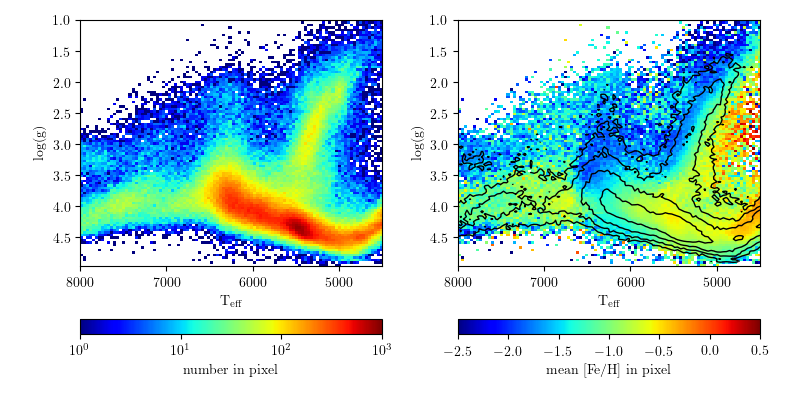
(SDSS surface gravity versus temperature for stars. From here)
A Summer at Microsoft Research
2 comments:
Topics:
academia,
Microsoft,
unsolicited advise

I spent the last few months only 10 miles away from UW, just across the lake in Redmond. Since lots of people have been interested in how the experience was, and since corporate internships seem to be fairly uncommon in Astronomy, I thought it would be worthwhile recapping my summer at Microsoft Research. (Apologies for a super lengthy post. tl;dr MSR was fun, challenging, would recommend)
The Reddit Effect - II
1 comment:
Topics:
Everyday Data,
technology,
unsolicited advise
Today I'll share a couple observations about web traffic. Take from it what you will.
Below are two charts/tables, directly taken from my "dashboard". The first lists my Top 10 Articles, ranked by total numbers of pageviews. This shows a smooth exponential-ish distribution, not too heavy on any single article.
(apropos: I really like the built-in stats tools with Blogger!)


This isn't to say that Reddit is the best place to advertise your work. It can go largely unnoticed if you don't participate in the Reddit community, and getting traction within any social news aggregator is often a subtle game. However, your potential exposure can be much higher than places like Facebook.
These stats also don't account for external exposure. For example, I'd wager more than 865 people read Huffington Post's coverage of my Starbucks post.
My intuition is that I need to diversify my readership sources some, that Reddit doesn't necessarily create a stable base (for a host of reasons). But I'm making this whole blog thing up as I'm going, just trying to do my best, so who's to say what's "best"?
Below are two charts/tables, directly taken from my "dashboard". The first lists my Top 10 Articles, ranked by total numbers of pageviews. This shows a smooth exponential-ish distribution, not too heavy on any single article.
(apropos: I really like the built-in stats tools with Blogger!)

The second chart lists the Top 10 Traffic Sources for this site. The traffic from Reddit is more than double that of all other sources combined! WOW!

This isn't to say that Reddit is the best place to advertise your work. It can go largely unnoticed if you don't participate in the Reddit community, and getting traction within any social news aggregator is often a subtle game. However, your potential exposure can be much higher than places like Facebook.
These stats also don't account for external exposure. For example, I'd wager more than 865 people read Huffington Post's coverage of my Starbucks post.
My intuition is that I need to diversify my readership sources some, that Reddit doesn't necessarily create a stable base (for a host of reasons). But I'm making this whole blog thing up as I'm going, just trying to do my best, so who's to say what's "best"?
Subscribe to:
Posts (Atom)