This wasn't the video I wanted to shoot. I had planned to talk about workflow and writing, but instead I spent the day saddened and outraged by what happened to a colleague...
What follows are some thoughts for them, and about systemic problems of racism and equity in academia we must address. Further, as a person who has been privileged, fortunate, and blessed beyond anything that is reasonable in this life, I have a moral duty to be an agent of this change.

Showing posts with label gender. Show all posts
Showing posts with label gender. Show all posts


Gender study at the IAU meeting
No comments:
Topics:
academia,
Astronomy,
gender

For any astronomers heading to Hawaii next week for the big IAU meeting, please consider helping me continue the study of gender demographics at astronomy conferences!
This conference brings together the largest and most diverse group of astronomers for 2 weeks of science and sunshine. It's also a perfect chance to continue my ongoing study of gender in speakers versus question askers.
The web form is here, and will be active for the entire 2 weeks of the conference!
See you in Hawaii!
Project: Gender in Conference Talks #AAS225
No comments:
Topics:
academia,
Astronomy,
gender

For anyone who will be attending the upcoming AAS 225 meeting next week in Seattle, WA, I want to give you a heads up to help participate in a study I will be conducting!
This is a follow-up to last year's pilot study I organized on gender in astronomy talks. I asked conference attendees to record the gender of the speakers and the questioners for every talk they attended, hoping to answer simple questions like: Do women get asked more questions by men or women? This unique and ongoing study is the first of its kind for Astronomy (that I'm aware of), and will hopefully help determine best practices for conducting meetings and talks to promote inclusiveness and interaction by all.
Our report from AAS 223 is here!
The study was also conducted at NAM 2014, and they wrote a very fine report about it here!
This year I'll be gathering data again using a simple web form that should work on computer/iPhone/etc. The goal is to make adding data painless while listening to the talks. We hope to get data on 100% of the talks this year, and will need help from as many people as possible.
Please help spread the word about the study, and contact me with questions/comments via Twitter or my website.
See you at #AAS225!
Survey is here!
Gender of White House Visitors
No comments:
Topics:
demographics,
Everyday Data,
gender,
Microsoft,
names

This dataset has been in the news before, and is (in my opinion) a great example of public disclosure that we should be pushing for in government. A whole other conversation of course is how/when such records should be released, and by whom. The White House Visitor dataset is also known to be incomplete, censoring records for national or personal security reasons, and maybe other reasons too.
Here is just one question I came up with: Do more men or women visit the White House? My guess was that a majority of visitors would be men.
Studying Gender in Astronomy Conferences: #NAM2014 Edition!
No comments:
Topics:
Astronomy,
gender
Folks: A quick shout out for some data gathering to help with...
I should have posted this earlier, but if you are at NAM (National Astronomy Meeting) 2014 in Portsmouth this week, please help collect data for their gender study!
More details here!
I should have posted this earlier, but if you are at NAM (National Astronomy Meeting) 2014 in Portsmouth this week, please help collect data for their gender study!
More details here!
Report: Gender in AAS Talks
7 comments:
Topics:
academia,
Astronomy,
gender
Today I'm proud to announce that my AAS 223 Hack Day project is finally finished! Our "paper" (really an informal report) on the study of gender in AAS talks has hit astro-ph:
http://arxiv.org/abs/1403.3091
This all started about 6 months ago when I was attending a different astronomy conference. I observed that the gender ratio for speakers seemed well balanced, as did the audience. Both were perhaps 60%/40% (Men/Women). However, the questions mostly seemed to be asked by men!
So I decided to organize a volunteer effort to study this. We collected data using a simple web-form (that Morgan Fouesneau graciously helped me make), and asked conference attendees to record the gender of every speaker and every question asker for talks they attended.
We got over 300 submissions! I was going to be happy with 100, and figured I'd have to beg a few friends to participate. This was enough data to make some interesting plots... and also just enough data to know that we need more data!
Here are a few highlights from the study:
We were very glad to see that the gender ratio of all the speakers matched that of the conference participants. This also closely matches the gender ratio of astronomers under the age of ~40 as reported in the AAS Demographics survey recently.
The significance of this result is debatable, but it's the first time I've seen data like this. I wonder how this varies with sub-field of the talks...
This result shocked me, and begs to be studied further. The session chair seems to greatly impacts the gender ratio of the questions being asked. What does this mean?! Are male session chairs preferentially selecting male questions? Are women less likely to speak up when an additional man is standing in front?
We need data on the format of the session to understand the origin of this result, and to make actionable suggestions/best-practices for future conferences!
But I'll need help doing it!
The upcoming AAS 225 in Seattle (Jan 2015) would be a perfect time to do a follow-up study. We need to gather more detailed data from every talk. A big volunteer effort might get us there, but if the AAS is interested in helping that could be a huge shot in the arm. We did this project with $0 spent and only social media / friends to help advertise. With the AAS's help we could get this data and help make our annual meetings even better!
Lastly, a huge thanks to the wonderful volunteers who sent us data, the organizers and sponsors of AAS Hack Day, and [Morgan, Erin, Alex, Katja, Laura] for making the analysis/writing happen!

http://arxiv.org/abs/1403.3091
This all started about 6 months ago when I was attending a different astronomy conference. I observed that the gender ratio for speakers seemed well balanced, as did the audience. Both were perhaps 60%/40% (Men/Women). However, the questions mostly seemed to be asked by men!
So I decided to organize a volunteer effort to study this. We collected data using a simple web-form (that Morgan Fouesneau graciously helped me make), and asked conference attendees to record the gender of every speaker and every question asker for talks they attended.
We got over 300 submissions! I was going to be happy with 100, and figured I'd have to beg a few friends to participate. This was enough data to make some interesting plots... and also just enough data to know that we need more data!
Here are a few highlights from the study:
1. Men ask disproportionally more questions than women in talks.
 |
| FS FQ = Female Speaker, Female Questions, FS MQ = Female Speaker Male Questions, etc |
We were very glad to see that the gender ratio of all the speakers matched that of the conference participants. This also closely matches the gender ratio of astronomers under the age of ~40 as reported in the AAS Demographics survey recently.
2. Women are asked slightly more questions per talk than men
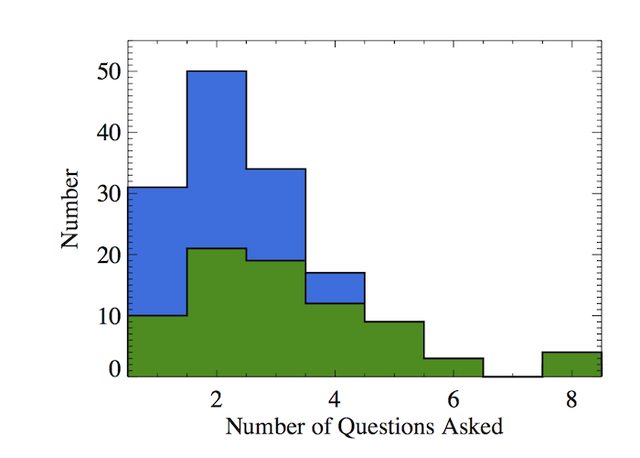 |
| Blue is talks by men, green is talks by women |
3. The gender of the session chair has a strong impact on the gender ratio of the questioners.
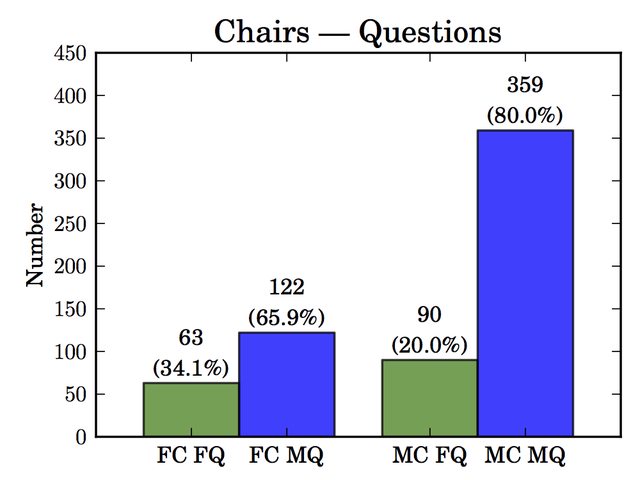 |
| FC FQ = Female Chair, Female Questions, FC MQ = Female Chair Male Questions, etc |
We need data on the format of the session to understand the origin of this result, and to make actionable suggestions/best-practices for future conferences!
The Future:
I want to conduct a more controlled follow up study! It's clear to me that there's more to learn, and maybe ways we can improve how our conferences are conducted.But I'll need help doing it!
The upcoming AAS 225 in Seattle (Jan 2015) would be a perfect time to do a follow-up study. We need to gather more detailed data from every talk. A big volunteer effort might get us there, but if the AAS is interested in helping that could be a huge shot in the arm. We did this project with $0 spent and only social media / friends to help advertise. With the AAS's help we could get this data and help make our annual meetings even better!
Lastly, a huge thanks to the wonderful volunteers who sent us data, the organizers and sponsors of AAS Hack Day, and [Morgan, Erin, Alex, Katja, Laura] for making the analysis/writing happen!
Update: this appears to be my 100th blog post on If We Assume!
Here's a sweet badge I awarded myself...
Gender in Science Talks
3 comments:
Topics:
Astronomy,
Everyday Data,
gender
Attention Fellow Astronomers!
If you'll be attending the upcoming AAS 223 in Washington DC, could you help me collect data for a project? This is for my "AAS Hack Day" idea.The project stems from an anecdotal observation I made at a recent meeting I attended: the gender ratio of speakers did not appear to be the same as the gender ratio of the people who asked them questions. Part of this was due to a good mix/balance of age and gender in the talk lineup, and part of it because "gray beards" (with a known gender skew) often ask questions from the audience. This begat a slew of other questions: e.g. do women prefer to ask women questions? Do some subfields have better gender parity in speakers vs questioners? Does the questioners gender ratio match the AAS attendance as a whole?
Data is clearly needed to study this...
So I'm reaching out to you, dear colleague. I need 2 things:
1. Help me collect data on the genders of speakers versus questioners!
2. Help me spread the word so I can sample many different sessions/subfields!
The data I need is simple:
- AAS Talk # (e.g. 123.45)
- Gender of the speaker
- Gender of the people who ask questions (a simple string of "MFMFMMFF" etc. is fine)
You can get me the data any way you like! Tweet it at me (@jradavenport), facebook msg me, email me (jrad - a t - uw.edu), scribble it on a cocktail napkin, carrier pigeons.... or best of all use this handy webform (many thanks to Morgan Fouesneau for putting this together!)
I'll be posting more about this study of gender equality in scientific talks in the future, and will be shamelessly posting reminders/pleas for help throughout AAS223! If you have any thoughts on the project please let me know!
And please, if you like this idea (even if you're not attending AAS), share it online with your fellow astronomers! Thanks!
Subscribe to:
Posts (Atom)